On eBird at the Tamarindo estuary
| Species | Months recorded | On checklists | Last record |
|---|---|---|---|
| Turquoise-browed Motmot Eumomota superciliosa | Common | November 8, 2026 |
few records · regular · on many checklists. Source: eBird, hotspot Tamarindo, Guanacaste, Costa Rica (L442998), checked on November 18, 2026. What you see depends on the tide, the season and the animals.
Motmots are a small family of birds of the American tropics, famous for their long tails. Birds of the World calls the turquoise-browed motmot surely one of the most flamboyantly plumaged of the family, distinct enough to have a genus of its own. Its range is small: the Yucatán Peninsula, and the Pacific slope of Central America from southern Mexico to northwest Costa Rica. That makes Guanacaste the southern end of its world.
How to recognize it
- The tail: long and bright blue. The two central feathers are twice as long as the rest and bare for more than half their length, ending in black-tipped turquoise «rackets».
- The face: a black mask with a turquoise eyebrow above it, which gives the bird its name.
- The body: mostly olive-green below with a cinnamon or rufous belly, and a darker reddish patch on the back. The flight feathers flash turquoise when it flies.
- The bill: dark, fairly long and slightly curved.
Both sexes have the racket tail, which is unusual for such an ornate trait (Wikipedia). The other motmot on the Tamarindo list, Lesson’s motmot, is a rare record here: seven weeks in the eBird archive, the latest on 14 July 2019.
Why it swings its tail
A perched motmot often moves its tail from side to side like the pendulum of a clock. In the Yucatán, Mayan speakers call it «clock bird» for this habit. Research cited by Wikipedia found that both sexes perform this wag-display when they spot a predator, as if to say «I have seen you». In males, a longer tail is also linked to better success at finding a mate.
A common story says the motmot plucks its own tail to make the rackets. It does not: the barbs near the tip are weakly attached and wear off with preening and rubbing against branches.
How it hunts and nests
The motmot is a sit-and-wait hunter. It perches on an open branch, a fence post or even a power line, watches the ground, and drops on insects and small reptiles, which it handles with its broad, serrated bill. It nests in a long tunnel dug into an earth bank, where it lays three to six white eggs.
Where and when to see it in Tamarindo
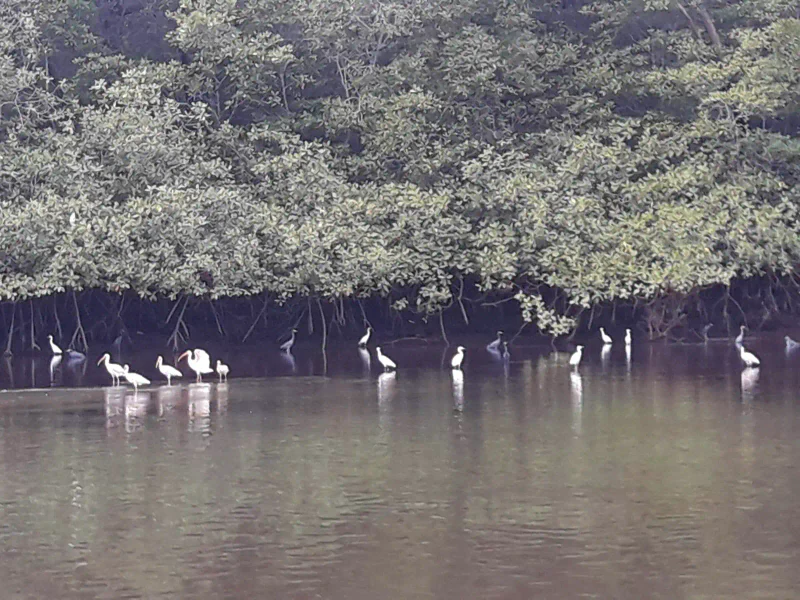
It prefers fairly open places: forest edges, gallery forest and scrub, and it seems to favor dry forest. At the Tamarindo eBird hotspot, which includes the estuary mouth, the mangrove edge and the edge of town, it is common: 44 of 48 weeks with records, in every month. As of 18 November 2026, the latest report is from 8 November 2026. The official list of the birds of Costa Rica (AOCR) lists it as a resident.
Look for it sitting still on a low, open perch at the edge of the trees, and watch for the swinging tail. It is a land bird, so the best chances are along the shore rather than out on the open water. As with any wild animal, nothing is guaranteed.
Names and national pride
In Costa Rica it is the momoto cejiceleste, or pájaro bobo, «foolish bird», a name that comes from its habit of letting people get close before it flies off (Wikipedia). In Nicaragua it is the guardabarranco, «ravine guard», and in El Salvador the torogoz, after its call. It is the national bird of both countries. The species is listed as Least Concern on the IUCN Red List (BirdLife International, 2020).
See it on a tour
Tell us you want to watch birds when you book the bird watching tour in Tamarindo, and your guide will also scan the trees along the shore. You can join by boat on the wildlife boat tour or by kayak on our kayak tour through the mangrove. Then meet another bird of the estuary edge, the white-throated magpie-jay, read our bird watching guide for Tamarindo, or browse the full Tamarindo bird checklist.
Watch, don’t feed. In Costa Rica, feeding wildlife without SINAC authorization is fined under article 116 of the Wildlife Conservation Law (Ley 7317). On our tours, animals are watched from a distance.
Sources
- Birds of the World: Turquoise-browed Motmot (introduction)
- Wikipedia: Turquoise-browed motmot
- AOCR: Lista Oficial de las Aves de Costa Rica (update June 2026)
- eBird: Tamarindo hotspot (L442998)
- eBird: bar charts for the Tamarindo hotspot
Reviewed: November 19, 2026 · Valled Tours