On eBird at the Tamarindo estuary
| Species | Months recorded | On checklists | Last record |
|---|---|---|---|
| White-throated Magpie-Jay Cyanocorax formosus | Common | October 29, 2026 |
few records · regular · on many checklists. Source: eBird, hotspot Tamarindo, Guanacaste, Costa Rica (L442998), checked on November 18, 2026. What you see depends on the tide, the season and the animals.
Few birds announce themselves like this one. White-throated magpie-jays move through the trees in small, noisy groups, and they often come closer to scold whoever is watching them. In Guanacaste they are part of daily life, from woodland edges and farmland to the trees that line the estuary.
How to recognize it
- Shape: a large jay with a very long tail and a thin crest that curls forward over the head (Birds of the World).
- Colors: blue wings, back and tail, with whitish edges on the tail; white breast, belly and face; a narrow black band across the chest. The legs and eyes are black and the bill is gray (Wikipedia).
- Male or female: females look like males but are duller above, with a narrower chest band and a shorter tail.
- Size: 43 to 56 cm from bill to tail tip, but only about 210 g. The tail makes the bird look much bigger than it is.
Nothing else in the Tamarindo area looks like it. The brown jay, also found in Costa Rica, is brown and lacks the curled crest.
A family of helpers
The magpie-jay breeds cooperatively, and its family rules are unusual. According to Birds of the World, the daughters stay in the group and help their parents raise the next broods, while the sons leave. A typical group is a dominant female, her mate and several grown daughters that feed her, the nestlings and the fledglings.
Wandering males visit several groups a day, and the social life gets complicated: helpers sometimes start a nest of their own, or even lay eggs in their mother’s nest for the group to raise. Researchers link this competition to an astonishing voice. A single male can produce upwards of 60 different calls, probably many more.
What it eats
Almost anything. Wikipedia, citing the Handbook of the Birds of the World, lists insects and caterpillars, frogs, lizards, the eggs and nestlings of other birds, seeds, fruit, grain and nectar from balsa flowers. Young birds take several years to learn all the foraging skills of their parents.
Where and when to see it in Tamarindo
The species lives on the dry Pacific slope from western Mexico to Costa Rica, in thorn forest, gallery forest, woodland edges and farmland, from sea level up to about 1,250 m. It does not migrate. At the Tamarindo eBird hotspot it is common, with records in all 48 weeks of the year; as of 18 November 2026, the latest report is from 29 October 2026.
On the estuary, listen before you look. Its calls carry from the trees at the edge of the mangrove, and a group crossing open ground is easy to follow by its long tails. The official list of the birds of Costa Rica (AOCR) lists it as a resident.
A new scientific name
For decades it was Calocitta formosa. Molecular studies showed that the genus Cyanocorax was not a natural group unless the magpie-jays were included, so both magpie-jays were moved into it (Wikipedia). eBird now uses Cyanocorax formosus. The species name means «beautiful» in Latin.
Is it threatened?
No. It is listed as Least Concern on the IUCN Red List (BirdLife International, 2020), and it is common across its range.
See it on a tour
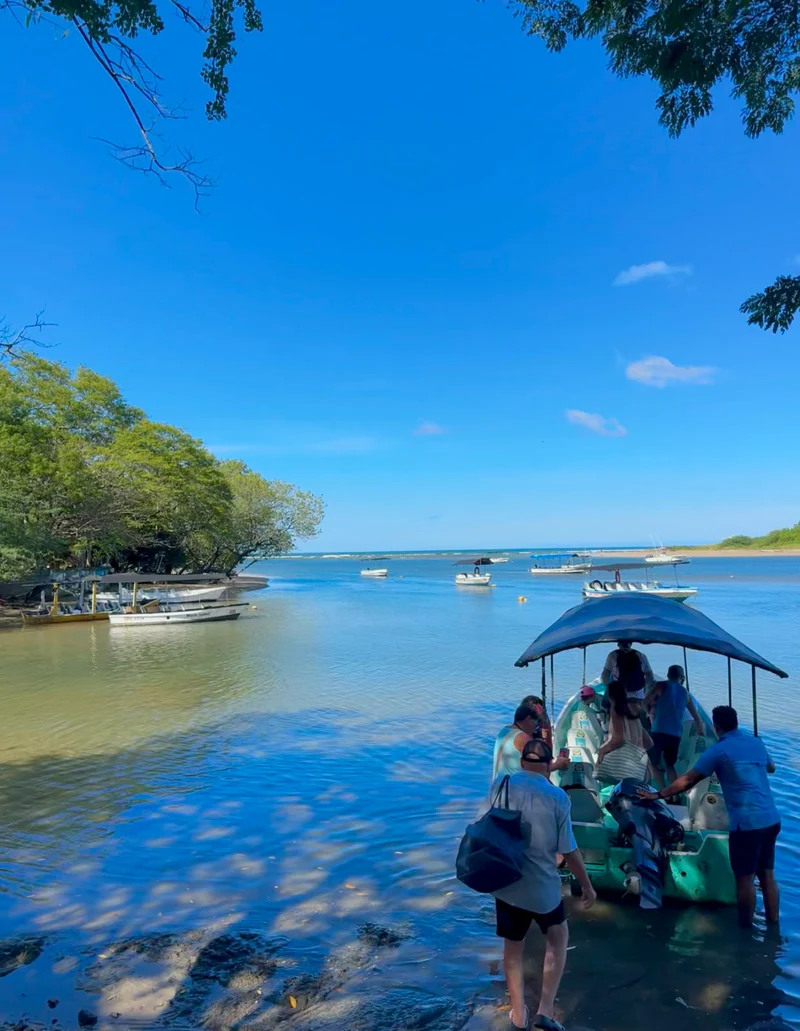
Look for it in the trees along the shore on our wildlife boat tour in the Tamarindo estuary. For another dry-forest bird of the estuary edge, meet the turquoise-browed motmot, and check the Tamarindo bird checklist for everything else. If birds are your focus, ask for the bird watching tour in Tamarindo.
Watch, don’t feed. In Costa Rica, feeding wildlife without SINAC authorization is fined under article 116 of the Wildlife Conservation Law (Ley 7317). On our tours, animals are watched from a distance.
Sources
- Birds of the World: White-throated Magpie-Jay (introduction)
- Wikipedia: White-throated magpie-jay
- AOCR: Lista Oficial de las Aves de Costa Rica (update June 2026)
- eBird: Tamarindo hotspot (L442998)
- eBird: bar charts for the Tamarindo hotspot
Reviewed: November 19, 2026 · Valled Tours