On eBird at the Tamarindo estuary
| Species | Months recorded | On checklists | Last record |
|---|---|---|---|
| Ringed Kingfisher Megaceryle torquata | Occasional | September 4, 2026 | |
| Belted Kingfisher Megaceryle alcyon | Occasional | November 14, 2025 | |
| Amazon Kingfisher Chloroceryle amazona | Occasional | May 16, 2026 | |
| Green Kingfisher Chloroceryle americana | Occasional | May 16, 2026 | |
| American Pygmy Kingfisher Chloroceryle aenea | Rare | July 31, 2014 |
few records · regular · on many checklists. Source: eBird, hotspot Tamarindo, Guanacaste, Costa Rica (L442998), checked on November 18, 2026. What you see depends on the tide, the season and the animals.
The five kingfishers at a glance
The official list of the birds of Costa Rica (AOCR, June 2026) has six kingfishers. Five of them are on the eBird list for the Tamarindo hotspot, which covers the estuary mouth, the beach, the mangrove edge and the edge of town (full Tamarindo bird list). Start with size and color (two big blue-gray, two green, one tiny green), then check the breast to tell male from female.
| Species | Size | Male | Female | In Tamarindo (eBird) |
|---|---|---|---|---|
| Ringed (Megaceryle torquata) | The largest kingfisher in the Americas | Blue-gray above, white collar, all rufous below | Blue-gray breast band edged in white, rufous belly | Occasional; 26 of 48 weeks, every month; last 4 Sep 2026 |
| Belted (Megaceryle alcyon) | 28–35 cm; smaller than Ringed | Blue-gray above, white below with one blue breast band | Same, plus a rusty band across the belly | Occasional winter visitor; mid-October to March; last 14 Nov 2025 |
| Amazon (Chloroceryle amazona) | About Belted size, much heavier bill | Dark oily green above, rufous breast | Narrower green breast band, no rufous | Occasional; 10 weeks; last 16 May 2026 |
| Green (Chloroceryle americana) | Small; much smaller than Belted | Glossy green, white spots on the wings, rufous breast | White breast with two green spotted bands | Occasional; 17 weeks; last 16 May 2026 |
| American Pygmy (Chloroceryle aenea) | Tiny; about half the size of Green | Green above, rusty below with white belly | Like the male, with a narrow green breast band | Rare; 2 weeks; last 31 Jul 2014 |
Plumage and size from the Cornell Lab (All About Birds, Merlin and Birds of the World). Frequency is our label from the weekly eBird bars for the hotspot, consulted 18 November 2026.
Ringed Kingfisher: the big one
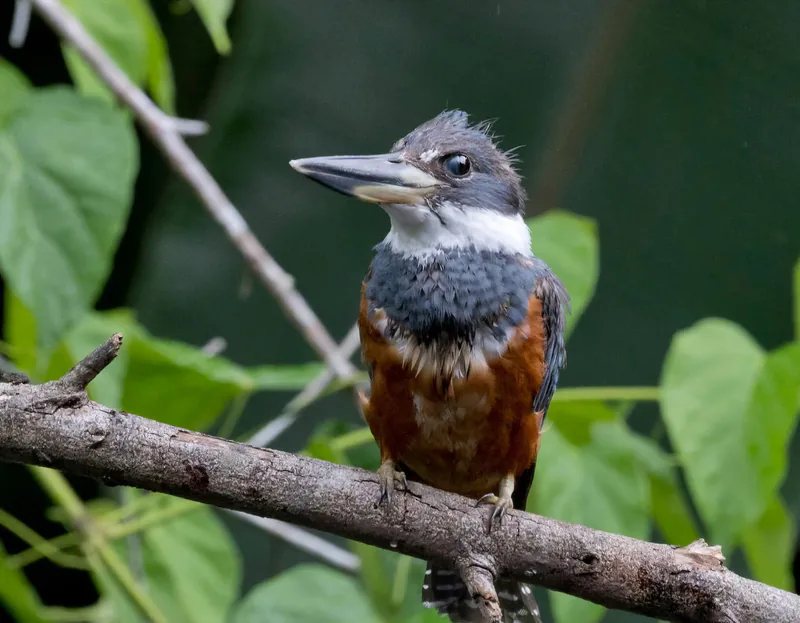
The Ringed Kingfisher is the largest kingfisher in the Americas, with an enormous bill and loud calls, according to Merlin. It likes high, open perches and often flies high overhead giving a loud «keck». It is mainly a freshwater bird, but Birds of the World notes that it also fishes along salt and brackish shores when it finds perches and prey.
In Tamarindo it is the kingfisher with the most records: 26 of 48 weeks, with at least one record in every month. The male is all rufous below. The female has a blue-gray band across the breast with a thin white line under it, above the rufous belly (All About Birds).
Belted Kingfisher: the winter visitor
The Belted Kingfisher breeds in North America, and most birds migrate south, some as far as northern South America (Birds of the World). The AOCR lists it as a migrant. At the hotspot its records run from the third week of October to the end of March, with none from April to mid-October.
It is blue-gray above and white below with a blue breast band, and the female adds a rusty band across the belly (All About Birds). So the color rule flips: in the Belted, it is the female who wears the rufous. Its loud rattle often gives it away first.
Amazon and Green: the two green kingfishers
The Amazon Kingfisher is about the size of a Belted, with a much more massive black bill, dark oily-green upperparts and no bold white spots on the wings. It often perches on wires or bare snags and flies low over the water (Merlin). Males have a rufous breast; females have a narrower green breast band (Birds of the World).
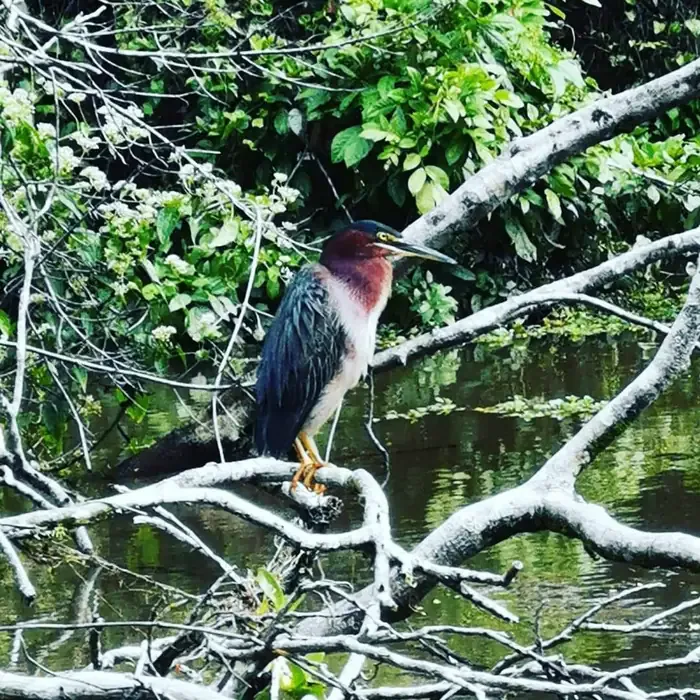
The Green Kingfisher is much smaller, with a long bill, white spots on the wings and white outer tail feathers that show in flight. It tends to perch low, on branches close to the water, and is easy to overlook (All About Birds). The male has a rufous breast; the female has two green bands across a white breast.
American Pygmy Kingfisher: do not count on it
The smallest of the five is a bird of shady forest streams and mangroves. It perches low and can dart away when disturbed, though it may stay put if approached quietly (Merlin). Its rusty underparts and the narrow green band of the female set it apart from the Green Kingfisher. In the Tamarindo archive it has only two weeks with records, and the latest is from 31 July 2014. It is on the list, but no tour can promise it.
How kingfishers fish
All five hunt in the same basic way: they wait on a perch over the water, spot a fish and plunge headfirst to grab it with the bill. The Belted often hovers over the water, bill down, before the dive (All About Birds); the Ringed rarely hovers for more than a few seconds, and the Green rarely hovers at all. Amazon Kingfishers fly back to the same perch, stun the prey and swallow it headfirst.
They nest in burrows dug into earthen banks near water. From a boat or kayak, look for a stocky, big-headed bird on a bare branch over the channel. What you see depends on the tide, the season and the birds.
Look for them with us
A quiet approach helps. Also see the Green Heron and our herons and egrets guide. You can paddle the mangrove by kayak (1.5 to 2 hours), take the wildlife boat tour in the Tamarindo estuary (about 2 hours), or join the bird watching tour in Tamarindo, always with a bilingual guide and a start time set by the tide.
Watch, don’t feed. In Costa Rica, feeding wildlife without SINAC authorization is fined under article 116 of the Wildlife Conservation Law (Ley 7317). On our tours, animals are watched from a distance.
Sources
- eBird: Tamarindo hotspot (L442998), consulted 18 Nov 2026
- eBird: bird list of the Tamarindo hotspot
- AOCR: Lista Oficial de las Aves de Costa Rica (update June 2026)
- All About Birds (Cornell Lab): Ringed Kingfisher identification
- All About Birds (Cornell Lab): Belted Kingfisher identification
- All About Birds (Cornell Lab): Green Kingfisher identification
- eBird / Merlin: Ringed Kingfisher
- eBird / Merlin: Amazon Kingfisher
- eBird / Merlin: American Pygmy Kingfisher
- Birds of the World: Ringed Kingfisher
- Birds of the World: Belted Kingfisher
- Birds of the World: Amazon Kingfisher
Reviewed: November 18, 2026 · Valled Tours