On eBird at the Tamarindo estuary
| Species | Months recorded | On checklists | Last record |
|---|---|---|---|
| Magnificent Frigatebird Fregata magnificens | Common | October 29, 2026 |
few records · regular · on many checklists. Source: eBird, hotspot Tamarindo, Guanacaste, Costa Rica (L442998), checked on November 18, 2026. What you see depends on the tide, the season and the animals.
The magnificent frigatebird is the easiest big bird to find at the Tamarindo estuary, and one of the hardest to see up close. It spends the day in the air over the river mouth and the beach, wings bent like a long, thin «M», steering with a forked tail. Cornell calls it a pterodactyl-like bird that soars on tropical breezes with hardly a flap. In Costa Rica most people call it tijereta, «little scissors», for that tail.
How to recognize it
Nothing else over the estuary has its shape. Long, narrow, angular wings, a long tail with a deep fork (often held closed in a single point) and a long bill with a hooked tip. It is bigger than the brown pelicans it flies with: the Cornell identification page gives a length of 89 to 114 cm, a wingspan of about 2.2 m and a weight of 1 to 1.9 kg.
Frigatebirds are the only seabirds in which males and females look strikingly different, Cornell notes. That makes it easy to sort the birds overhead:
- Adult male: all black. During courtship he inflates a bright red throat pouch like a balloon; outside the breeding season it is barely visible.
- Adult female: black with a dark head and a white chest. She is also bigger than the male: the Audubon field guide gives females a wingspan of 2.3 to 2.4 m and males 2.1 to 2.3 m.
- Young birds: white head and white belly, with a pale tan bar on the upper wing. The head darkens as they age.
In flight it rarely flaps, and when it does the beats are slow and deep. It is usually silent away from the colonies.
A seabird that cannot sit on the sea
Frigatebirds have webbed feet, yet they rarely land on the water. Unlike other seabirds, they lack waterproof feathers, Cornell explains. Their oil gland produces very little oil, so the plumage would get soaked, and with short legs they could not take off again easily (Wikipedia, Frigatebird). They even bathe on the wing: they fly low, splash at the surface and preen afterwards.
Instead of diving like a pelican, a frigatebird snatches food from the surface with its hooked bill, barely touching the water. According to Audubon it eats mostly small fish, plus squid, jellyfish and crustaceans, and scavenges scraps around fishing boats and docks.
Why it is called a pirate
The frigatebird also steals. It chases terns, boobies and other seabirds in mid-air, pecks and harasses them until they drop or throw up their catch, then dives and grabs the food before it hits the water. That habit earned it the old name «man-o-war bird». Learning to do it takes practice: Cornell describes young frigatebirds carrying sticks and chasing each other, with one diving to catch the stick when the other drops it.
Over the estuary mouth, watch what happens when a tern flies in with a fish. If a frigatebird is above, a chase often follows.
Where and when to see it in Tamarindo
At the Tamarindo eBird hotspot, which covers the mouth of the estuary, the beach and the edge of town, the magnificent frigatebird is common: it appears on checklists in all 48 weeks of the year. As of 18 November 2026 the latest report is from 29 October 2026. The official list of the birds of Costa Rica (AOCR, June 2026) lists it as a resident.
From the boat, look up over the open water where the estuary meets the sea, and scan the sky above the line of pelicans. Frigatebirds often hang almost still in the wind, high up, so a pair of binoculars helps. Like any wild animal it is never guaranteed: it depends on the wind, the season and the birds.
Nesting and conservation
Magnificent frigatebirds nest in colonies on islands, usually in mangroves or low trees, on a flimsy platform of sticks (Audubon). Perched males display in groups with their red pouches inflated while females fly overhead and choose a mate.
The species is listed as Least Concern on the IUCN Red List (BirdLife International, 2020). Audubon notes that the total population is hard to monitor and has probably declined at some tropical colonies.
A fun fact
Raising a single frigatebird chick takes about a year. Both parents incubate the egg for around 56 days; the chick stays in the nest until it is about 167 days old, and the female keeps feeding it until it is one year old (Cornell).
See it on a tour
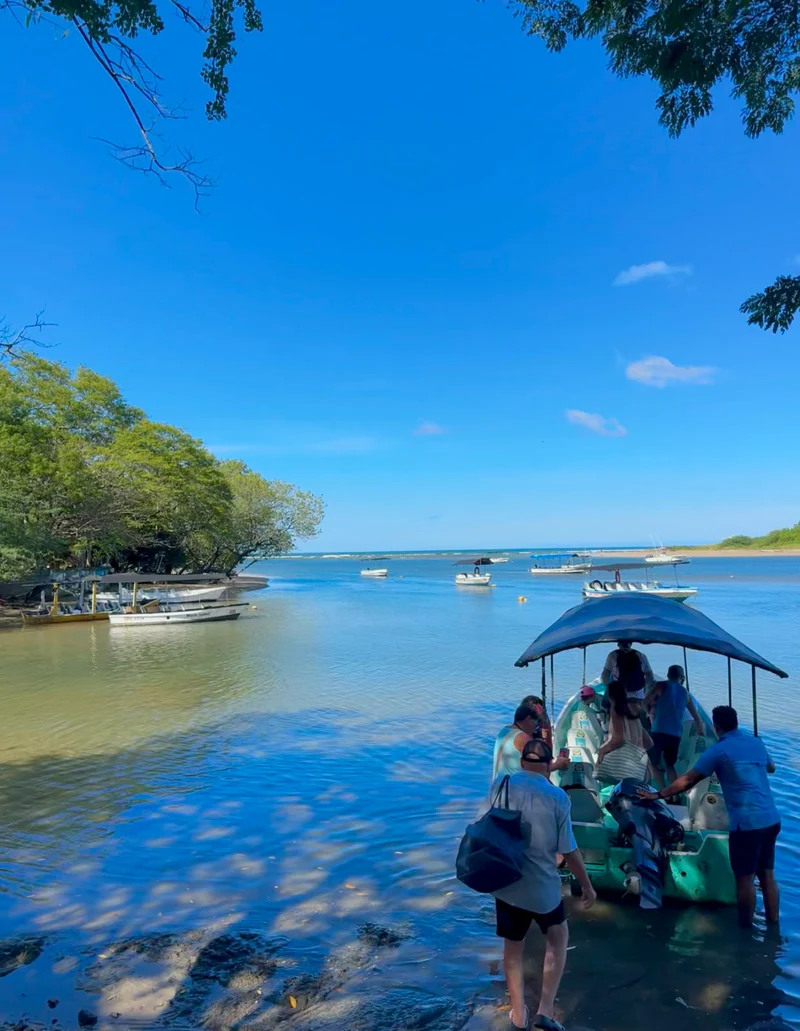
Our wildlife boat tour in the Tamarindo estuary passes the open water near the mouth, where frigatebirds patrol with the brown pelicans and the osprey. If birds are your focus, tell us when you book and join the bird watching tour in Tamarindo. Down on the mud you can then look for the white ibis, tick off more species in the Tamarindo bird checklist, or keep exploring the field guide.
Watch, don’t feed. In Costa Rica, feeding wildlife without SINAC authorization is fined under article 116 of the Wildlife Conservation Law (Ley 7317). On our tours, animals are watched from a distance.
Sources
- Cornell Lab, All About Birds: Magnificent Frigatebird (overview)
- Cornell Lab, All About Birds: Magnificent Frigatebird (identification)
- Audubon Field Guide: Magnificent Frigatebird
- Wikipedia: Frigatebird
- AOCR: Lista Oficial de las Aves de Costa Rica (update June 2026)
- eBird: Tamarindo hotspot (L442998)
- eBird: bar charts for the Tamarindo hotspot
Reviewed: November 19, 2026 · Valled Tours