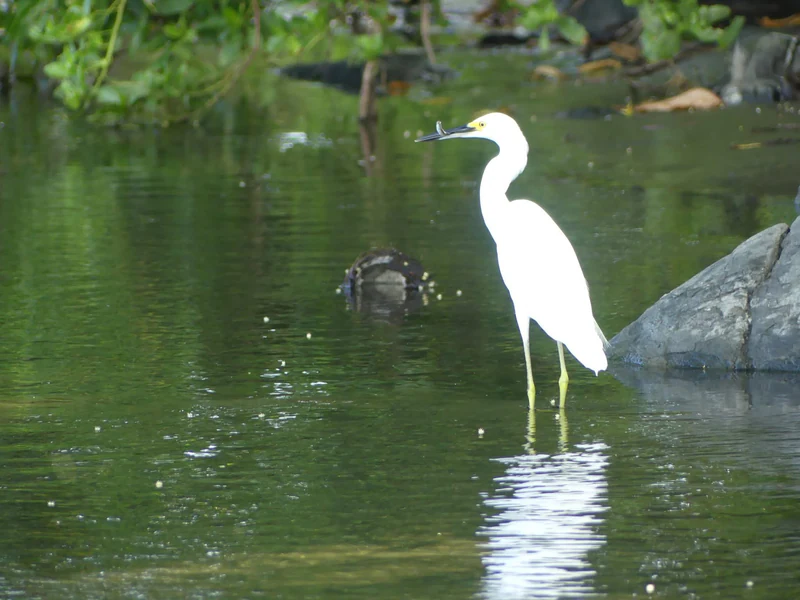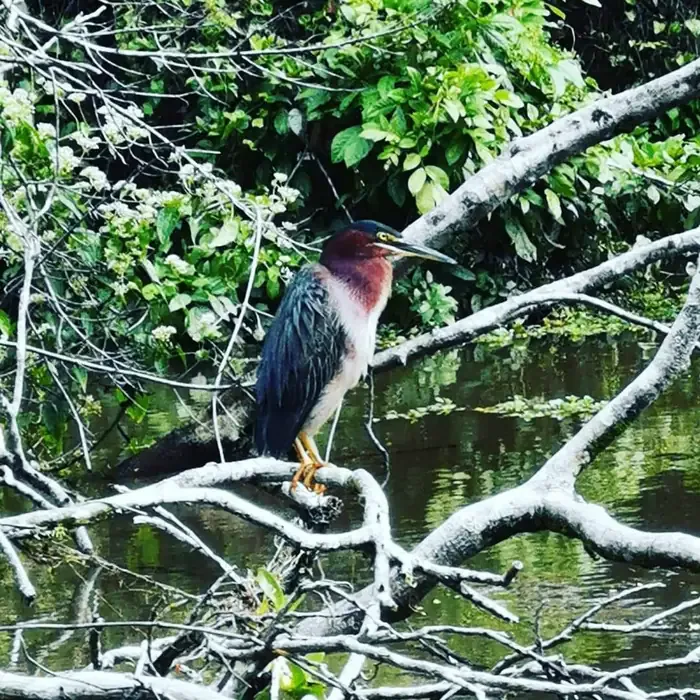
On eBird at the Tamarindo estuary
| Species | Months recorded | On checklists | Last record |
|---|---|---|---|
| Reddish Egret Egretta rufescens | Frequent | May 2, 2026 |
few records · regular · on many checklists. Source: eBird, hotspot Tamarindo, Guanacaste, Costa Rica (L442998), checked on November 18, 2026. What you see depends on the tide, the season and the animals.
Most herons hunt by standing still. The reddish egret does the opposite. It races through the shallows, stops, turns, flicks its wings open and stabs at small fish. If you see a heron that looks like it is dancing on the mudflat, check this page first.
How to recognize it
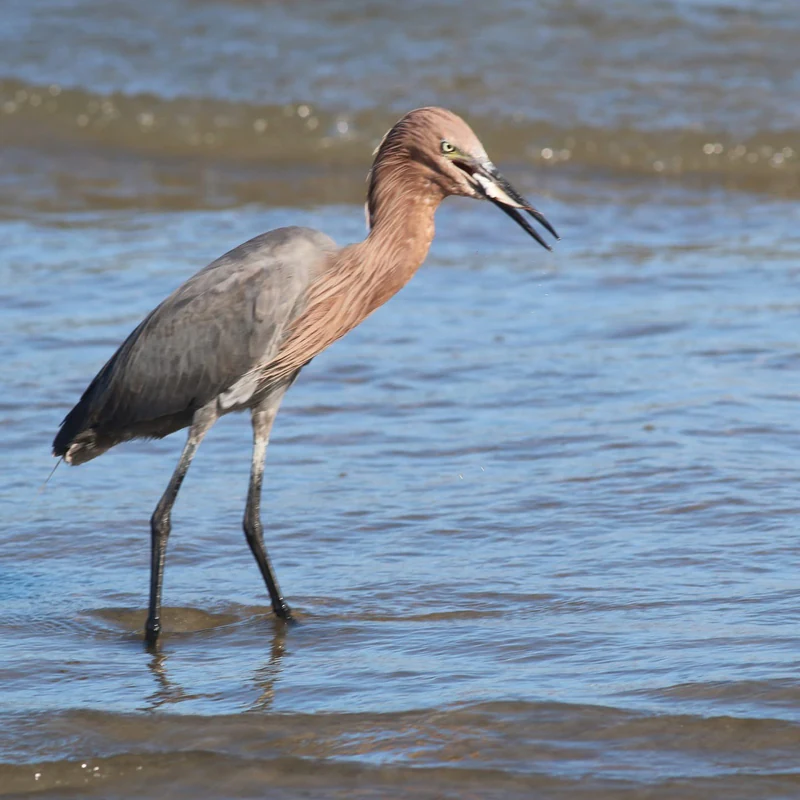
It is a fairly large, powerfully built heron with long legs, a long neck and a thick, dagger-like bill. Cornell places it between the snowy egret and the great egret in size. The feathers of the head and neck often stick out, so the bird looks shaggy, as if it just got out of bed.
It comes in two forms, and a bird keeps its form for life, according to the Audubon field guide:
- Dark form: grayish-blue body with a pinkish-cinnamon head and neck. This is by far the more common form, and the one in our photo.
- White form: all white. It is much scarcer, and easy to mistake for another white egret.
In both forms, breeding adults have a two-toned bill: pink at the base and black at the tip. Outside the breeding season the base of the bill turns dusky. The legs are cobalt blue. Young birds are an ashy copper color with a dark bill, unlike any other heron.
Two look-alikes share the estuary. The little blue heron is also dark, but it is smaller, never shaggy, and hunts slowly. The tricolored heron has a white belly. Our guide to the herons and egrets of Costa Rica has a full comparison table.
The dance: how it hunts
The Audubon field guide describes it running through shallows with long strides, staggering sideways, leaping in the air, raising one or both wings and stabbing at fish. Each move has a purpose:
- Opening the wings for a moment startles fish into moving.
- Canopy feeding: the egret spreads its wings over its head like an umbrella. The shade attracts fish looking for cover and removes the glare, so the bird sees its prey clearly, Cornell explains.
- Stirring with the feet flushes prey from the bottom. It can even do this while hovering in flight.
- Herding: it can chase fish on foot or swoop at them in flight and push them toward land.
Its food is mostly small, minnow-like fish, with some shrimp and crabs. It usually hunts in very shallow salt water, about 5 to 15 cm deep, on flats, lagoons and the edges of mangroves. It normally hunts alone, but joins big mixed groups of herons, pelicans and ibises when fish get trapped in drying pools.
When to see it in Tamarindo
At the Tamarindo eBird hotspot, which covers the mouth of the estuary, the beach and the edge of town, the reddish egret is frequent. There are records in every month except June, and most fall between November and May. As of 18 November 2026, the latest report at the hotspot is from 2 May 2026.
It does not breed in Costa Rica. BirdLife International lists the country as part of its non-breeding range, and the Museo Nacional de Costa Rica catalogs it as migratory. So it is a visitor here. Look for it where the water is shallow and open; whether it shows up depends on the tide, the season and the bird itself, so treat each sighting as a good day.
Why it is Near Threatened
BirdLife International lists the reddish egret as Near Threatened on the IUCN Red List (2020 assessment). The species has a large range, but it uses a narrow habitat and is patchily spread, so the population is small: BirdLife estimates 5,000 to 9,999 mature individuals, and decreasing.
Cornell adds that the 2025 State of the Birds report counts it among the species that lost more than half of their population in the past 50 years. The main threats are stronger and more frequent storms, coastal development, and disturbance at nesting colonies and feeding areas. A quiet approach helps: keep your distance and let it hunt.
A fun fact
Color does not matter in love. When reddish egrets pair up, males and females do not seem to care which form their mate is, and one nest can hold chicks of both colors, Cornell notes.
See it on a tour
The reddish egret is one of the birds we look for on our bird watching tour in Tamarindo. It also shares the estuary with the rest of the herons on the wildlife boat tour. For more species, browse the wildlife field guide or the Tamarindo bird checklist.
Watch, don’t feed. In Costa Rica, feeding wildlife without SINAC authorization is fined under article 116 of the Wildlife Conservation Law (Ley 7317). On our tours, animals are watched from a distance.
Sources
- Cornell Lab, All About Birds: Reddish Egret (overview)
- Cornell Lab, All About Birds: Reddish Egret (identification)
- Cornell Lab, All About Birds: Reddish Egret (life history)
- Audubon Field Guide: Reddish Egret
- BirdLife DataZone: Reddish Egret, IUCN Red List
- Museo Nacional de Costa Rica: Catálogo de Especies de Garzas de Costa Rica
- eBird: Tamarindo hotspot (L442998)
- eBird: bar charts for the Tamarindo hotspot
Reviewed: November 19, 2026 · Valled Tours