What the Tamarindo Wildlife Refuge was
Costa Rica first protected the estuary with Executive Decree No. 17566-MAG of June 23, 1987. Three years later, Law No. 7149 of June 27, 1990, published in La Gaceta No. 121 the same day, created the Refugio Nacional de Fauna Silvestre Tamarindo: a national wildlife refuge of roughly 500 hectares. Those dates come from the government summary filed with the Ramsar Convention in 1993, and Law 7149 is cited again in a 2009 review of the mangroves of Costa Rica’s north Pacific by researchers of the University of Costa Rica (UCR).
On June 9, 1993, the refuge was added to the list of wetlands of international importance as Ramsar site 610, “Tamarindo”. The Ramsar information sheet describes about 400 hectares of mangrove that were still largely intact, and the original Spanish sheet gives a single reason for the listing: the site is habitat for a large number of waterbirds.
What it is today
The refuge no longer works as a separate unit. Today the estuary lies inside a national marine park managed by the National System of Conservation Areas (SINAC) through its Tempisque Conservation Area, which covers the whole Nicoya Peninsula and protects, in SINAC’s words, mangroves, wetlands and the habitat of waterbirds, among other things. Scientists still use the old name for the place: a 2018 fish study in the Revista de Biología Tropical simply calls it the Tamarindo estuary.
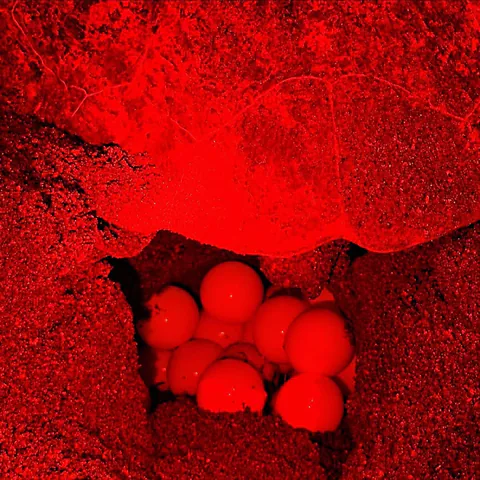
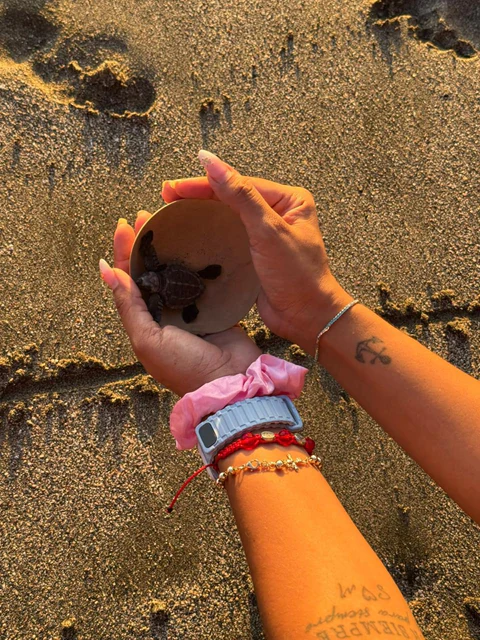
The marine park is also known for its nesting beaches north of the river mouth. That is a different subject: this guide stays in the mangrove, the channels and the animals that use them.
In short: the Tamarindo Wildlife Refuge was created by decree in 1987 and by Law 7149 in 1990, became Ramsar site 610 in 1993, and is now part of a national marine park run by SINAC through the Tempisque Conservation Area.
The Matapalo River and the channels
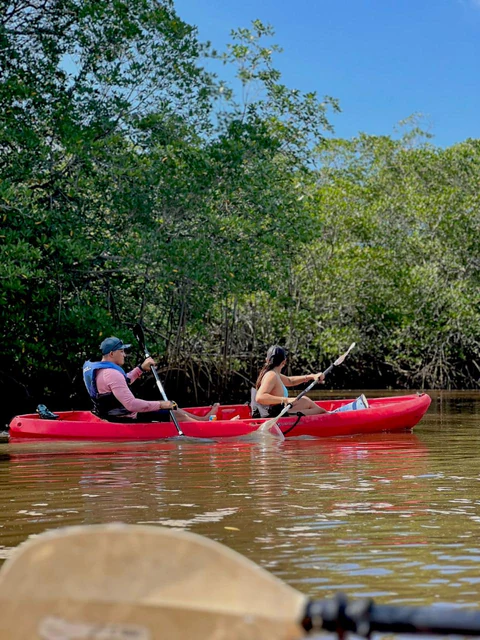
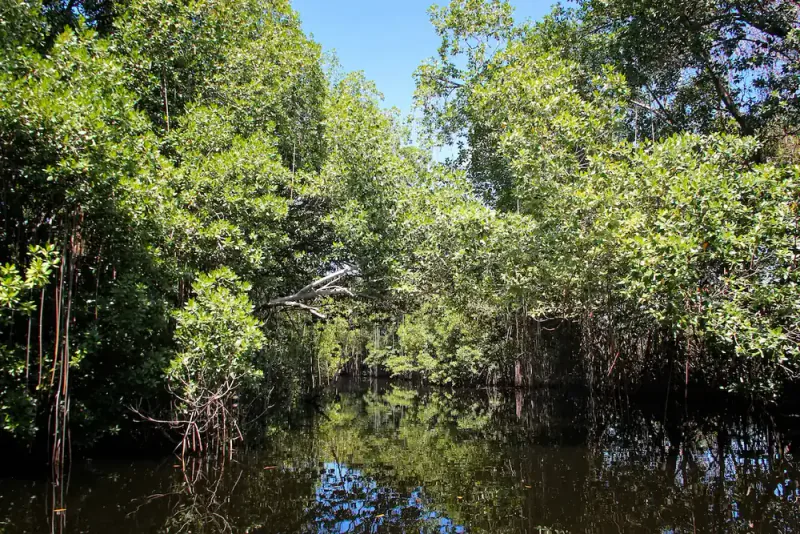
The estuary is fed by the Matapalo River and by smaller streams; the 2018 fish study names the Matapalo, the San Andrés, Quebrada Honda and Quebrada Barco. The Ramsar sheet describes a main channel more than 2 km long that splits into two or three secondary channels, leaving islands of red mangrove in between. Those are the channels a boat or a double kayak follows.
The same sheet explains why the water usually feels calm. High tides bring gradual changes rather than strong currents, and low tides uncover thin layers of mud between the roots. That mud is full of holes: crabs dig tunnels that let surface water soak in and bring buried minerals back up. The Matapalo is a short river with little capacity for big floods, so the mangrove is mature and stable, with few patches of regrowth. It was not always untouched: the sheet notes that trees were cut in the past for firewood for the salt works.
Five mangroves you can recognize from the boat
Mangroves are trees that live with their roots in salty or brackish water. In the Tamarindo estuary, red mangrove makes up about 70 to 75 % of the forest, with trees 25 to 30 m tall and 45 cm across, according to the Ramsar sheet. The other species are fewer but easy to spot once you know the clues. The descriptions below follow the mangrove species guide of INCOPESCA, Costa Rica’s fisheries and aquaculture institute.
Red mangrove (Rhizophora mangle)
Look for arching stilt roots that leave the trunk above the waterline and plunge into the channel. Red mangrove grows with “its feet in the water” right at the edge, as INCOPESCA puts it. Its seeds sprout while they are still on the tree, so you will see long, pencil-shaped propagules hanging from the branches. Studies of the estuary place it in the front row along the channels, mixed further inland with a second species, Rhizophora racemosa.
Black mangrove (Avicennia germinans and A. bicolor)
In Costa Rica it is called palo de sal, the salt tree, because in the dry season salt crystals can form on its leaves. Its clue is in the mud: hundreds of short pneumatophores, breathing roots that stick up like pencils around the trunk. Two species grow here, and A. bicolor is the scarcer one. They stand further back, in the interior of the mangrove, where the soil is saltiest.
White mangrove (Laguncularia racemosa)
Oval, fleshy leaves with a reddish base, where two tiny pores help the tree get rid of excess salt. Its small fruits look like almonds and its flowers grow in tight clusters. The 1993 Ramsar sheet uses the local name caballero.
Buttonwood (Conocarpus erectus)
Known locally as mariquita or botoncillo. It prefers drier ground at the edge of the mangrove and close to the beach. It has small, hard leaves and dark brown bark, and its round fruits grow in clusters that look like buttons.
Tea mangrove or piñuela (Pelliciera rhizophorae)
The rarest of the five here. Its long leaves grow in a circle like the top of a pineapple, hence the name piñuela; the flowers are large, white and solitary, and the fruit is shaped like a heart. The UCR review explains that this species is rarely found in salty north Pacific mangroves, which is why only a few trees grow here, mixed with red mangrove at the front of the forest.
| Mangrove | Best clue from the water | Where in the estuary |
|---|---|---|
| Red | Arching stilt roots, hanging propagules | Channel edges and mangrove islands |
| Black (palo de sal) | Pencil-like breathing roots in the mud, salt on the leaves | The interior, where the soil is saltiest |
| White (caballero) | Fleshy oval leaves with a reddish base, almond-like fruit | Mixed with the others |
| Buttonwood (mariquita) | Button-like fruit clusters, small hard leaves | Drier edges, near the beach |
| Piñuela | Leaves in a pineapple-like rosette, large white flowers | A few trees at the front of the mangrove |
Sources: Ramsar sheet for site 610 (1993), INCOPESCA mangrove species guide and Zamora-Trejos and Cortés (2009).
Tamarindo Wildlife Refuge animals
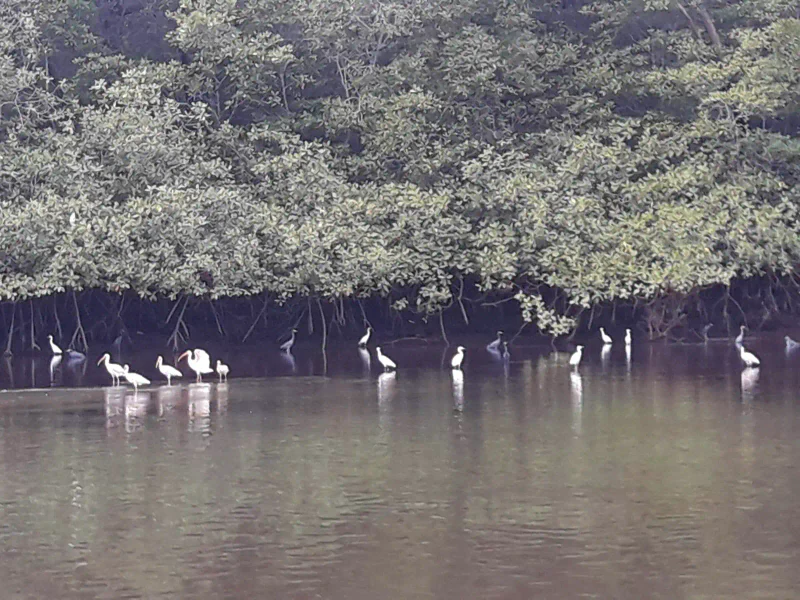
The Ramsar sheet describes a wetland where a large number of freshwater and saltwater waterbirds live, along with mammals and reptiles. Below is what the official records show, group by group. What you actually see on a given day depends on the tide, the season and the animals themselves, so treat this as a guide to possibilities, not a promise.
Waterbirds
The best bird data comes from eBird, the bird-sighting database of the Cornell Lab of Ornithology. Its Tamarindo hotspot sits at the mouth of the estuary and also covers the beach and the edge of town, not only the mangrove. It had 292 species on record when we checked on November 18, 2026. Our labels (common, frequent, occasional, rare) summarize how often each bird shows up on eBird checklists through the year.
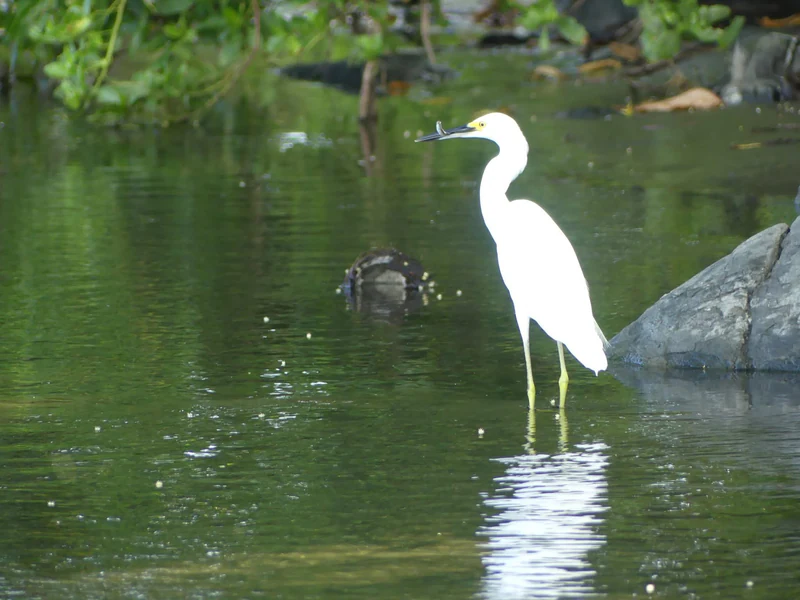
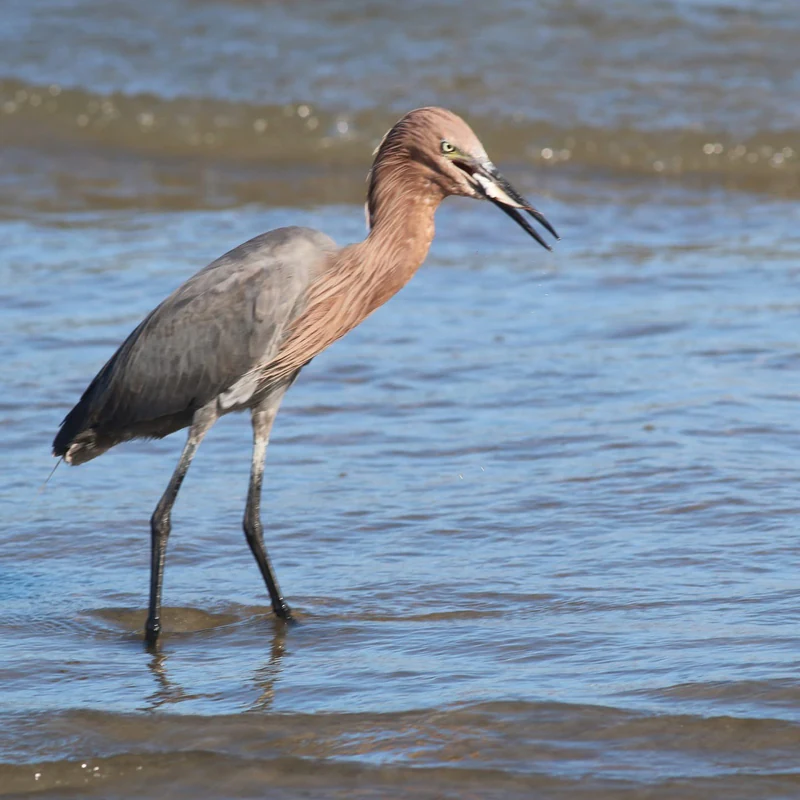
Common in the records: great egret, tricolored heron, white ibis, neotropic cormorant, brown pelican, magnificent frigatebird and mangrove swallow. Frequent: snowy egret, little blue heron, reddish egret, green heron, yellow-crowned night heron, osprey and Hudsonian whimbrel. Occasional: ringed, green and Amazon kingfishers, the belted kingfisher (a winter visitor), anhinga, wood stork and the mangrove form of the yellow warbler. Rare: mangrove hummingbird (last record in 2019), mangrove vireo, mangrove cuckoo and American pygmy kingfisher (last record in 2014).
| Species | Months recorded | On checklists | Last record |
|---|---|---|---|
| Great Egret Ardea alba | Common | November 16, 2026 | |
| Tricolored Heron Egretta tricolor | Common | November 16, 2026 | |
| White Ibis Eudocimus albus | Common | September 30, 2026 | |
| Neotropic Cormorant Nannopterum brasilianum | Common | November 16, 2026 | |
| Brown Pelican Pelecanus occidentalis | Common | November 16, 2026 | |
| Mangrove Swallow Tachycineta albilinea | Common | October 11, 2026 | |
| Snowy Egret Egretta thula | Frequent | November 16, 2026 | |
| Little Blue Heron Egretta caerulea | Frequent | September 25, 2026 | |
| Reddish Egret Egretta rufescens | Frequent | May 2, 2026 | |
| Green Heron Butorides virescens | Frequent | September 4, 2026 | |
| Yellow-crowned Night Heron Nyctanassa violacea | Frequent | August 8, 2026 | |
| Osprey Pandion haliaetus | Frequent | October 26, 2026 | |
| Ringed Kingfisher Megaceryle torquata | Occasional | September 4, 2026 | |
| Green Kingfisher Chloroceryle americana | Occasional | May 16, 2026 | |
| Anhinga Anhinga anhinga | Occasional | August 21, 2026 | |
| Mangrove Yellow Warbler Setophaga petechia | Occasional | August 21, 2026 | |
| Mangrove Hummingbird Chrysuronia boucardi | Rare | March 13, 2019 |
few records · regular · on many checklists. Source: eBird, hotspot Tamarindo, Guanacaste, Costa Rica (L442998), checked on November 18, 2026. What you see depends on the tide, the season and the animals.
For identification tips, see our guides to the herons and egrets of Costa Rica, the kingfishers of the estuary and bird watching in Tamarindo, or browse the whole wildlife field guide.
The Ramsar sheet lists several birds as threatened within the reserve, among them the osprey, the great black hawk, the zone-tailed hawk, the collared forest-falcon and the brown pelican. On eBird the brown pelican is common and the osprey frequent; the great black hawk is occasional, and the zone-tailed hawk and collared forest-falcon are rare.
Crabs
Crabs are the engine of the mangrove floor. The Ramsar sheet notes that the ground is riddled with tunnels dug by crabs, which carry water and organic matter down and bring mud and minerals back up. INCOPESCA explains in its talk on why mangroves matter that crabs, bacteria and other microorganisms break fallen mangrove leaves down into detritus, the fine organic matter that feeds a large number of other animals.
Two groups are easy to notice. Fiddler crabs (genus Uca in the older literature) wave one oversized claw on the mud banks at low tide; the UCR review lists them for mangroves in Guanacaste. Mangrove tree crabs climb roots and trunks. On the Pacific coast they belong to their own species, Aratus pacificus, separated in 2014 from its Caribbean twin; a 2015 study in Zootaxa compared the larvae of the two using crabs from both coasts of Costa Rica.
Crabs also feed many of the birds you came to see. The Cornell Lab notes that the yellow-crowned night heron eats mostly crabs and crayfish, and that the white ibis probes the soft mud by feel to pull out crabs and worms.
Fish
Fish stay hidden under the water and between the roots, but they are the main reason the estuary matters (see the next section). The herons, cormorants, kingfishers and ospreys hunting over the channels are the visible sign that they are there.
Mammals
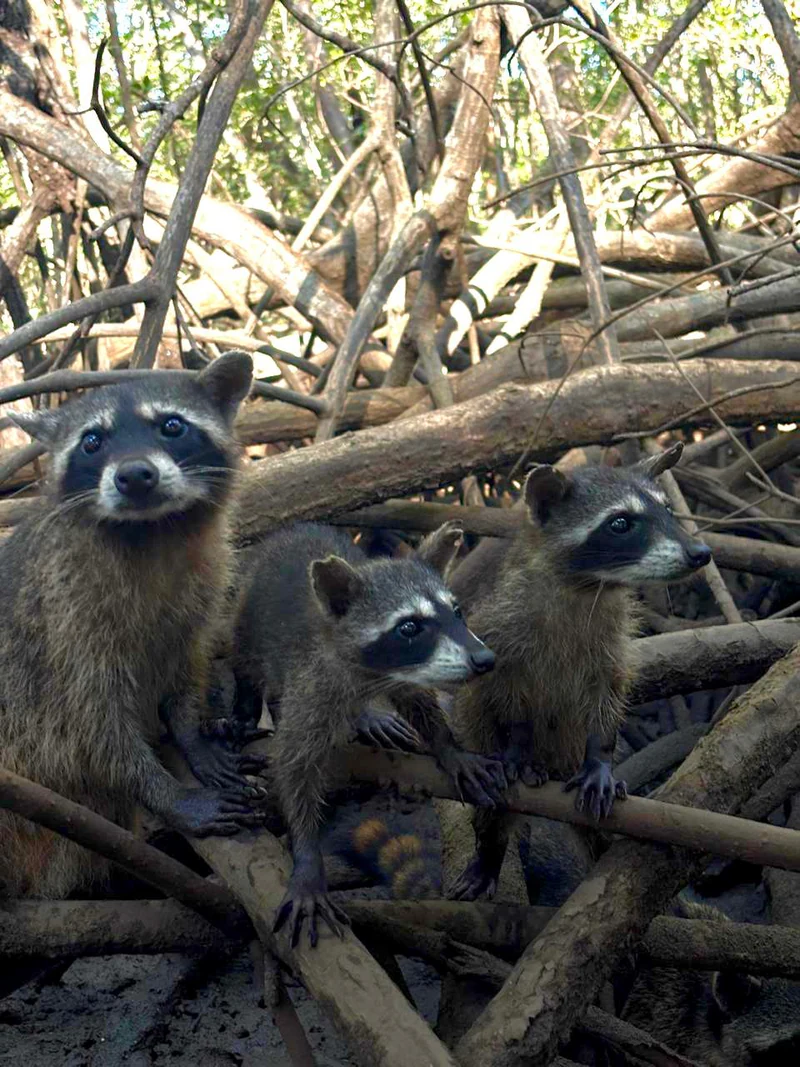
The original Ramsar sheet lists the common opossum (zorro pelón) and the variegated squirrel, and the 1993 sheet counts the false vampire bat (Vampyrum spectrum) among the threatened species. Raccoons are regulars at the edge of the mangrove; the photo below is from our own tours. A study in another coastal national park of Costa Rica found that raccoons there ate mainly crabs, plus fruits and seeds, and that leftovers from people, plastic wrappers included, also turned up in their droppings. Howler monkeys appear in the site records as well.
Reptiles
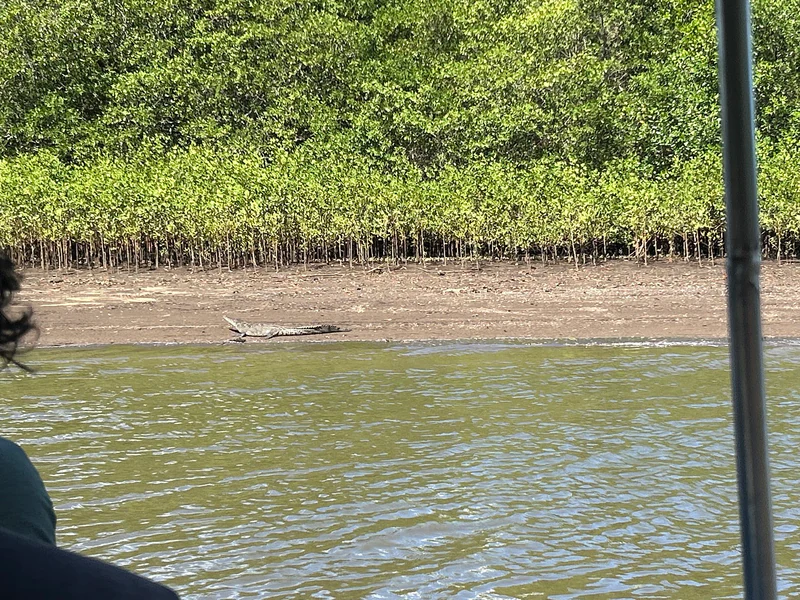
Ramsar lists two crocodilians in the estuary, the American crocodile and the spectacled caiman, and the green iguana and the spiny-tailed iguana (garrobo) are in the site records too.
Why the mangrove matters: a nursery for fish
The strongest local evidence is a study by Ortiz-Araya and colleagues, published in 2018 in the Revista de Biología Tropical, the science journal of the University of Costa Rica. The team sampled five mangrove stations six times between August 2009 and June 2010 and identified 1,357 fish of 59 species from 28 families.
- The families with the most species were the jacks (Carangidae) and the snappers (Lutjanidae).
- The most abundant were livebearers (Poeciliidae), mullets (Mugilidae) and sardines and herrings (Clupeidae).
- Snappers such as the spotted rose snapper were associated with the saltier water near the mouth, and snook (Centropomus) with the less salty water inside.
- The middle of the estuary was the most diverse part, with up to 30 species.
The authors saw young fish using red mangrove roots as cover and concluded that several species important to fisheries recruit in this estuary. They also warned that it is fragile and vulnerable to pollution because its mangrove area is small and its water shallow.
That matches what INCOPESCA says about mangroves in general: they are feeding, breeding and nursery grounds for the larvae and young of commercial and non-commercial species. In the Pacific mangroves of Panama, for example, six species of penaeid shrimp spend their juvenile stage among the roots before returning to the sea.
Can you visit the Tamarindo Wildlife Refuge?
Yes, and it helps to know what it is. The refuge is a protected wetland inside a national marine park, not a zoo or an animal sanctuary, and the animals are wild. Park rules, entrance fees and opening hours are set by SINAC and can change, so we do not quote them here. If you plan to go on your own, check with the Tempisque Conservation Area first.
Tamarindo Wildlife Refuge tours
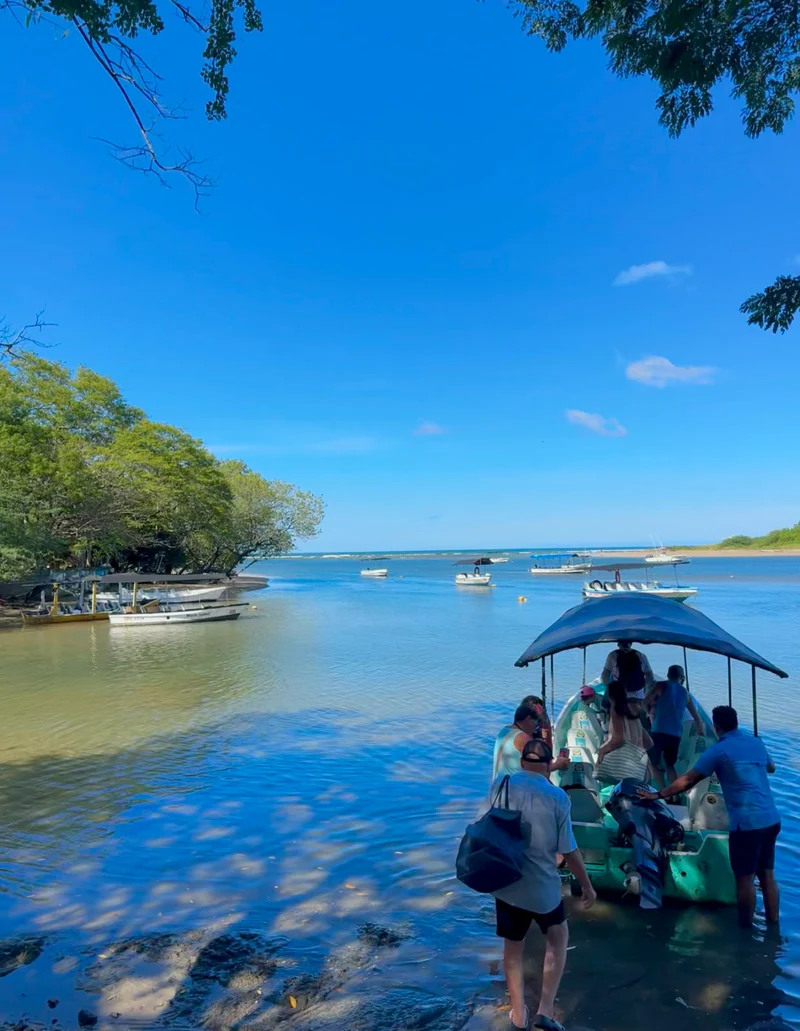
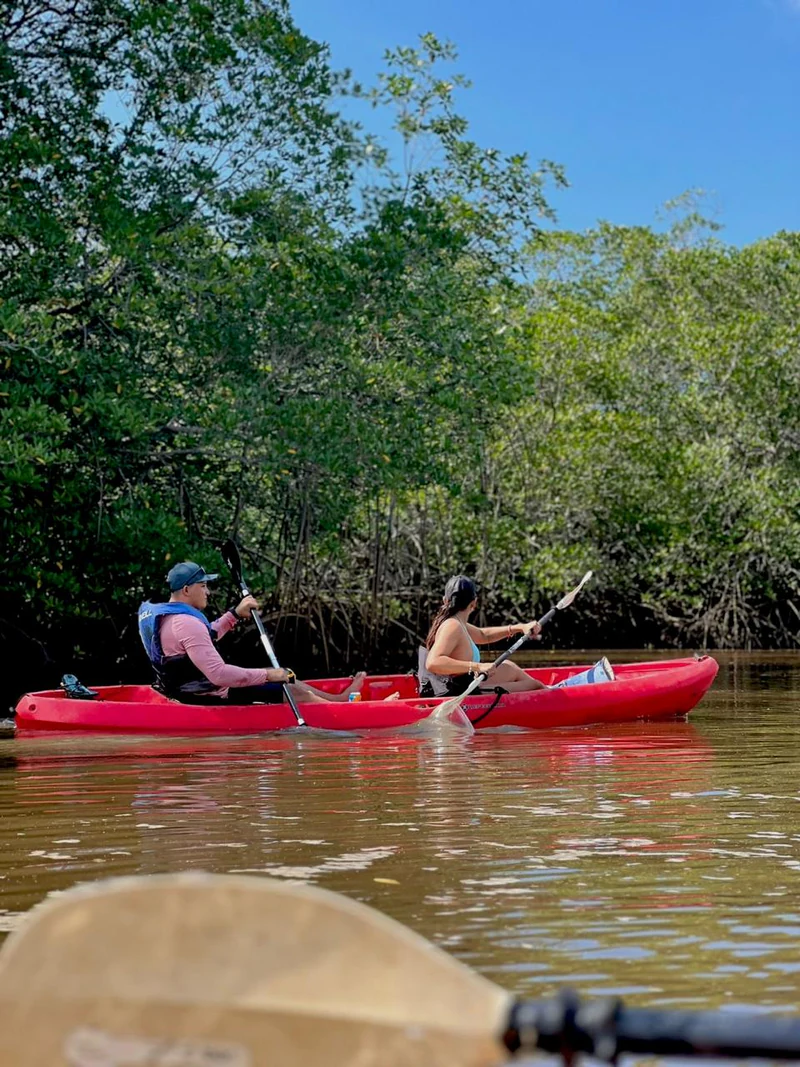
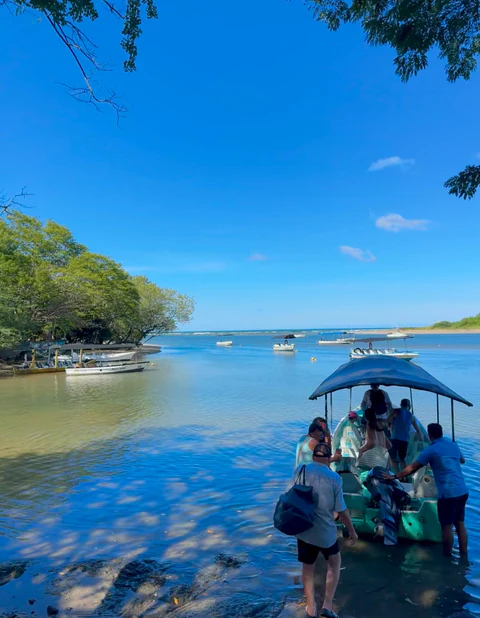
The most practical way to see the mangrove is from the water. Valled Tours runs two wildlife tours through the estuary: a boat tour of about two hours and a double-kayak tour of an hour and a half to two hours. Both include a bilingual guide and seasonal fruit, and the departure time depends on the tide. We meet in front of the booth at the park entrance, on the Tamarindo estuary.
Is there a Tamarindo Wildlife Refuge map?
SINAC publishes official maps of the protected areas of the Tempisque Conservation Area, including the national marine park that now contains the estuary. The Ramsar page for site 610 shows where the wetland is. For our meeting point, we send you the location by WhatsApp when you book.
Visiting rules: how to behave in the refuge
- Do not feed any animal. Article 116 of Costa Rica’s Wildlife Conservation Law 7317 fines anyone who, without SINAC authorization, gives food or unauthorized substances to wild animals.
- Keep your distance. Use binoculars or a zoom lens instead of moving closer, and let your guide decide how near the boat or kayak goes.
- Do not touch or take anything. Leave crabs, shells and mangrove propagules where they are.
- Take your trash with you. The estuary is small and shallow, and the 2018 fish study names pollution as one of its main risks.
- Keep voices low. A quiet group hears more birds and disturbs less.
See the refuge from the water
The channels of the old refuge are best seen slowly. Join our wildlife boat tour in the Tamarindo estuary for a relaxed two hours with a bilingual guide, or paddle the mangrove by kayak if you prefer silence and a closer look at the roots. If birds are your main reason to come, read about our bird watching tour in Tamarindo.
Sources
- Ramsar Sites Information Service: Tamarindo (site 610)
- Ramsar information sheet for site 610 (1993, English translation)
- MIRENEM summary of the refuge for Ramsar: Law 7149 and Decree 17566-MAG (1993, Spanish)
- Original Ramsar information sheet for site 610, with fauna and flora lists (1993, Spanish)
- eBird: Tamarindo hotspot (L442998), checked November 18, 2026
- Ortiz-Araya et al. (2018). Fish fauna of the Tamarindo estuary. Revista de Biología Tropical 66 (Suppl. 1)
- Zamora-Trejos and Cortés (2009). Los manglares de Costa Rica: el Pacífico norte. Revista de Biología Tropical 57 (3)
- INCOPESCA: Especies de manglar, guide to mangrove species
- INCOPESCA: Importancia de los manglares (talk by the fisheries research department)
- SINAC: Tempisque Conservation Area
- SINAC: national marine park page, Tempisque Conservation Area
- SINAC: maps of the protected areas of the Tempisque Conservation Area
- Carrillo, Wong and Rodríguez (2001). Food habits of the raccoon in a coastal park of Costa Rica. Revista de Biología Tropical 49 (3-4)
- Rebolledo, Wehrtmann and Cuesta (2015). Larvae of the mangrove crabs Aratus pacificus and A. pisonii. Zootaxa 3949 (2)
- Cornell Lab, All About Birds: Yellow-crowned Night Heron life history
- Cornell Lab, All About Birds: White Ibis life history
- Law 7317, Wildlife Conservation Law (Costa Rica), article 116
Reviewed: November 18, 2026 · Valled Tours