On eBird at the Tamarindo estuary
| Species | Months recorded | On checklists | Last record |
|---|---|---|---|
| Yellow-crowned Night Heron Nyctanassa violacea | Frequent | August 8, 2026 | |
| Black-crowned Night Heron Nycticorax nycticorax | Rare | March 13, 2019 |
few records · regular · on many checklists. Source: eBird, hotspot Tamarindo, Guanacaste, Costa Rica (L442998), checked on November 18, 2026. What you see depends on the tide, the season and the animals.
Most herons are long and slender. Night herons are built differently: thick-necked, short-legged for a heron and with a heavy bill. By day they often stand hunched and still among the mangrove branches, which is why many visitors float right past them. Two species are on the eBird list for the Tamarindo hotspot, and the odds of seeing each are very different.
Yellow-crowned night heron: the crab-eater
This is the night heron you are most likely to meet in the estuary. The Audubon field guide describes adults as mostly gray with a black-and-white face. Up close, the head is glossy black with white cheeks and a pale yellow crown, and the eyes are orange to red. The legs are yellow and turn coral, pink or red during courtship, according to Wikipedia’s species account. It is 53 to 71 cm long and weighs 770 g to 1 kg.
Young birds are brown with pale spots and streaks, and they take about three years to look like adults. In flight, the feet stick out well past the tail.
Its diet is more specialized than that of most herons. Audubon says it eats mainly crabs and crayfish, especially near the coast, and that its stout bill seems adapted to hard-shelled crustaceans, which is why some people call it the «crab-eater». It walks slowly in shallow water or on land, or stands still and waits. Small crabs are swallowed whole; with large ones it pulls off the legs, eats the body first and the legs last, and later coughs up the hard shell as a pellet.
That diet suits a mangrove. The Ramsar file for Tamarindo describes crabs digging tunnels in the mangrove mud, and our page on mangrove crabs explains who they are.
Black-crowned night heron: the rare one here
The black-crowned night heron is one of the most widespread herons on Earth: Audubon notes that it nests on every continent except Australia and Antarctica. Adults have a black cap and back and gray wings, and the young are brown with white spots. It feeds mostly from late evening through the night, mainly on fish, and roosts in trees by day. Its call is a loud, barking «kwok» or «quawk», often heard after dark.
In Tamarindo, though, it is rare. The hotspot has records in only 5 of the 48 weeks of eBird’s year, and as of 18 November 2026 the latest report is from 13 March 2019. If you think you see one, look twice: a young yellow-crowned night heron is also brown and spotted.
How to tell them apart
| Mark | Yellow-crowned | Black-crowned |
|---|---|---|
| Adult head | Black, with white cheeks and a pale yellow crown | Black cap |
| Adult back | Gray | Black |
| Bill | Thick and short | Black in adults |
| Main food | Crabs and other crustaceans | Mostly fish, but varied |
| In Tamarindo (eBird) | Frequent: 24 of 48 weeks | Rare: 5 of 48 weeks |
Field marks from the Audubon field guide and Wikipedia. Frequency from the weekly eBird bars for the Tamarindo hotspot, consulted 18 November 2026.
When and where to look in the estuary
Wikipedia notes that the yellow-crowned night heron may forage at any time of day or night, and Audubon adds that on the coast its feeding may follow the tides. Scan low branches over the water and the mud banks along the mangrove edge, where crabs come out of their burrows.
At the hotspot, the yellow-crowned night heron is frequent, with records in every month except July and September. As of 18 November 2026, the latest report is from 8 August 2026. Like any wild animal, it is never guaranteed: what you see depends on the tide, the season and the bird.
In Costa Rica both species are resident and migrant: the official list of the birds of Costa Rica marks both with those two codes, and the heron catalog of the Museo Nacional lists them as resident-migratory from sea level to 1,000 m.
Are they in trouble?
No. Audubon lists both as Least Concern on the IUCN Red List. The yellow-crowned night heron looks stable and has spread north in some areas; the black-crowned night heron declined in the 20th century from habitat loss and pesticides such as DDT, and many populations recovered after DDT was banned. The Museo Nacional lists both as Least Concern in Costa Rica.
A fun fact
The yellow-crowned night heron was brought to Bermuda on purpose. Wikipedia reports that it was introduced there at the end of the 1970s to control land crabs, which were digging holes in golf courses.
See them on a tour
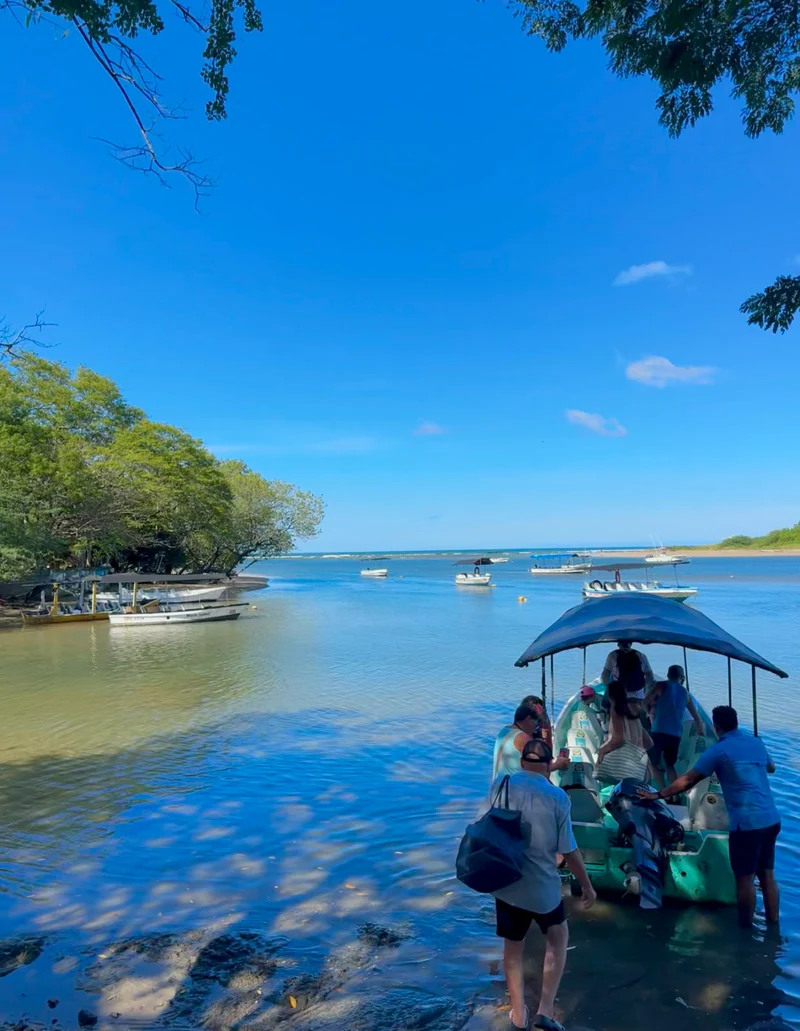
Night herons sit still, so a guide who knows the mangrove helps a lot. Join our wildlife boat tour in the Tamarindo estuary or the bird watching tour in Tamarindo. Next, compare them with the small green heron or read the full guide to the herons and egrets of Costa Rica.
Watch, don’t feed. In Costa Rica, feeding wildlife without SINAC authorization is fined under article 116 of the Wildlife Conservation Law (Ley 7317). On our tours, animals are watched from a distance.
Sources
- Audubon Field Guide: Yellow-crowned Night Heron
- Audubon Field Guide: Black-crowned Night Heron
- Wikipedia: Yellow-crowned night heron
- AOCR: Lista Oficial de las Aves de Costa Rica
- Museo Nacional de Costa Rica: Catálogo de Especies de Garzas de Costa Rica
- Ramsar Sites Information Service: Tamarindo (610)
- eBird: Tamarindo hotspot (L442998)
- eBird: bar charts for the Tamarindo hotspot
Reviewed: November 19, 2026 · Valled Tours